Showing posts with label writing. Show all posts

Thursday, June 7, 2012

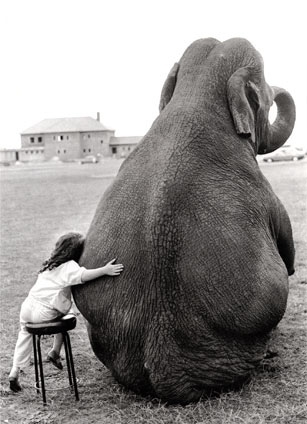
An Ode to the Elephant: My Own Poem

Just for fun...


This is an Ode to the Elephant
It’s not that I did a stint
in India 
or Africa 
that these
gray monstrosities
capture my attention,
my affection,
despite their forgetful 
representation.
No, you see,
it’s their majesty, 
that makes me reply,
to that dull guy,
asking “What animal would you be?”
“A dolphin,” 
says the girl from 
the sorority,
“A jaguar,” 
says the boy from
behind the bar,
“An ELEPHANT!” I cry, 
wide and far.
“Because they’ve got big ears for listening, 
big noses for smelling, 
big eyes for seeing, 
big feet for stomping.
they’re not afraid of being big and fat,
they’re alright with that. 
That means they’ve got more life, 
they’ve got more sense,
they never regret emails just after they’re sent.
They don’t sit it out on the bench, 
No, they’re grand but sweet too, 
fit to carry royalty,
they live in jungles,
I’d like a small one for a pet, 
but that’s silly,
who’d want to clean up after it wet
the floor?
but I like them anyway, 
they’re a cute set,
they’re funny and sweet and dangerous to boot, 
and always trumpeting when it all comes to,
they’re kind of like me
or how I wish to be,
so that’s why I reply
to that dull guy,
asking, “What animal would you be?”
AN ELEPHANT, I cry!


Friday, March 9, 2012

Roam: Chicago, Wrapped in the Cozy Blanket of AWP12

Last week was the arrival of a much anticipated event: my very first AWP Conference.

For those of you who don't concern yourselves with the inner-workings of the literary world, AWP stands for Associated Writers and Writing Programs. Each year, they host the largest annual conference of writers, editors and publishers in a different city. This year, it was in Chicago.

I hadn't planned on going to the conference. It all seemed too far off, too professional, too grand for a little first-year poet MFA like me. But I changed my mind after listening to a 25 minute reminiscence/laugh fest about last year's conference at a staff meeting for our literary journal.
"You must go." Our managing editor commanded us timid interns. She looked us each dead in the eye around the conference table and we nodded with quaking hearts.

Whether our attendance was to be for our own benefit or to have more hands to man our table at the Bookfair, I know not. Either way, we booked our flights, booked our hotel, booked our registration, and I was on my way to the Windy City.

I had no idea what I was getting myself into. To give you some idea of the insanity of this event, I will henceforth refer to it as the Writer's Olympics, or the Writer's World Cup. 10,000 writers descended upon Chicago in a literary frenzy, carrying fresh business cards and smart phones with thumbs stretched and ready to tweet. Having been to World Youth Day twice (aka Catholic Olympics, Catholic World Cup, etc.), which generally has attendees numbering in the millions, I was alright with the crowds. In fact, I thrive off of that kind of collective energy. What I couldn't deal with was the pressure: the pressure to be at the best panel, the best reading, the best off-site event at any given moment. The Olympics ran from Wednesday to Saturday: the Bookfair's 550 booths continuously stretching out in the nooks and crannies of the basement of the Hilton Chicago like some monstrous Kraken of the sea, hovering beneath the various ballrooms hosting the panels. The panels themselves gave me heart palpitations, with as many as 20 panels/readings happening at a time. Each featured experienced and well-known writers, editors, and publishers expounding on subjects like Connecting with Readers via your Website and Social Media or The Art of Writing a Joke. There were panels on publishing via your iPhone, on writing with violence, how to write about loss, when a text becomes feminist...you get the picture.  Then came the more than 200 off-site events synchronously happening in different parts of Chicago.

I did my best. I averaged 2/3 panels a day, some of which I ducked out of early if they got too boring. I'd run down to the Bookfair or drop in on another. I loved The Art of Writing a Joke featuring Alan Shapiro, at which he and his friends essentially told their favorite dirty jokes for an hour. I didn't learn too much, but I got a good laugh.

My major highlight of the week was meeting my ultimatefavorite contemporary poet: Kim Addonizio. I love her. I love her poetry.
Now, I've met a few famous poets in my day. At Gonzaga, we had Jane Hirshfield, Carolyn Forché and Li Young-Lee come to read, come talk to the poetry classes. We even had a small mixer at Spokane's Atticus for the poetry students with Sharon Olds(!) Through all these, I kept my calm. But I've always wanted to meet Kim Addonizio because she clinched poetry for me. I'd always liked poetry, but it wasn't until I read her work that I realized what poetry could be, its wide potential. She's sassy. Her poems are wild, surprising and different. So I brought my book of hers with me to the World Cup and planned to go to her panels and meet her afterwards. It was my number one goal. I had a speech planned. One that went something like, "Hi, it's such an honor to meet you. I'm a young poet and your poetry really inspired me at a crucial point in my life. It made me decide to be a poet. Would you sign my book?" and then step back and be quiet.

This is not what happened.
Instead, I was at the Bookfair, chatting with some lady at some booth about their summer writing program featuring Billy Collins and Joyce Carol Oates, when I saw Kim's name in little print. This is what went down.

"Oh Kim Addonizio's on here! I love her."
"Oh really? She was just here...actually she's right there." and the lady helpfully pointed her out at the next booth.
I spun around wildly and didn't think at all before I launched.
Me, breathless: "Hi Kim?!"
Kim: "Uh, yes?"
Me, shaking her hand for too long: "Hi, I'm Colleen, I just wanted to say that I'm such a fan of your poetry, and it really clinched being a poet for me, it's just so inspring (speaking faster and faster now) andIwenttoGonzagandstudiedunderTodMarshallwhointerviewedyouonceandhegaveusyourbookanditreallychangedmywholelifebecausenowI'mgettingmyMFAandIhaveWhatisThisThingCalledLovebutnotyourlatestbook."
Kim: "Have some coasters. They're for my new book."
Me: "Thanks!!!! I'll see you at your panels!"

I then ran away, almost bumping into several people. I'm pretty sure I went blind for a few moments. I forgot to ask her to sign my book. It took an hour for my adrenaline to die down. But I still met her!!!!!

The second highlight of the Olympics was Friday night. Some of the girls and I decided to show up late for the HowtobeanAlcoholic panel at the bars of Chicago and go to the Poets Laureate Reading to hear Philip Levine and Carol Ann Duffy (Britain's Poet Laureate).

I went looking forward to hearing Philip Levine, and left entranced by Carol Ann.

I have never heard any poet read the way she read. Carol Ann Duffy is one of those languid women that seem to float on the air they breathe. She quite simply slinked up to the podium, and began to speak in a slow, thick voice, a voice that normally would sound quite drunk, if it weren't for her sharp, dry observations and perfect timing. Her poetry was phenomenal, and I listened breathlessly, attentive to every inflection, every word. As we were sitting there, listening to this great poet of our time, I got the feeling that such events are supposed to give: this wonderful feeling of nowness, of being part of this world, of the privilege that comes with hearing history speaking from the stage in front of me and knowing myself to be part of it simply because I was there. There were well over a thousand writers in that ballroom listening to Duffy read, but it was wonderfully personal. I was discovering new poetry to love, and isn't that really what it's all about? So much of the literary world today is focused on the career aspect of writing: on making connections, networking, researching, reading everything, so as not to get left behind. And I don't necessarily condemn that...it has made a very vague kind of vocation more specific, more accessible, and I am most certainly benefitting from the modern approach to writing (as one friend likes to put it, I'm good at the internet.) For more on the subject, check out this article from the New York Review.  It sums up my feelings about it quite nicely.
But boy, do I enjoy it when all those things fall away and I stop thinking about myself, my writing, stop  wondering if I could write something like the poetry I'm hearing. How glorious it was to just hear some poems and like them and know that I could never, ever, ever write the way she does, because it's a voice so very Duffy, how glorious to just sit back and fall in love with poetry, with words, with art again because I'm absorbed in the story being told, in the beauty of a turn of phrase. I want to own it, these things, that story, that turn of phrase, but I can't, even if I bought the book or wrote my own perfect lines...I can't own it, and trying to write something just as good won't give it to me. All I can do is listen.
The Bookfair was a pleasure in and of itself. I bought my friend Claire Mcquerry's excellent first book, Lacemakers, and had her sign it. I spent a lot of time at the table handing out flyers and just chatting with the people that came by. These chats can lead to a variety of connections, and a few of the second and third years left in excitement over possible book deals and publishing opportunities, but as a first year, I don't have so much ready for publication, so was free to wander the fair for my own amusement, with no agenda to push as so many at AWP do. It was wonderful, perusing the booths, talking to editors who'd normally never give me the time of day (people are nice when they're hoping you'll buy something). I subscribed to Tin House and Agni and The Fairytale Review and bought more books than I had suitcase space for. I even bought a mug from the Rumpus, seen here. I'm not a mug collector, but this one: I couldn't resist.

It was strange to be with so many of my "people." Writers either dress terribly or wonderfully, and everyone looks the same. We talk the same too. We went out with a few MFAs from Maryland and it struck me: the surreal similarity of our conversations. I almost applied to Maryland, and it was reassuring to realize that I could go to any school for my MFA, and though the program would be different, the conversations would be the same. It was comforting, this sense of a national community.
I've read some critiques of AWP, mostly by misanthropic writers who have an issue with the incestuous "Aren't we wonderful?!" collective selfbackslap of the writer's community and I have to say that yes, yes, we are.

Tuesday, February 21, 2012

Short Story: Flash Fiction

The Ancient
When he was older, when his children had grown, his wife had died, and he had no more worries to keep him in bed staring at the ceiling, he took to walking through the darkest parts of the city at night. He gazed up at his zenith point, and thought about Copernicus and Galileo, about Johannes Kepler and Tycho Brahe. He left his world behind, pretended that he was an ancient, in a world where nothing was discovered and everything was new. 
Sometimes he even reached up, fancying that if he could circle the moon with his finger and his thumb, he could hook it and swing beyond his limits. He took the path through the park, through the ghetto, under the bridge: too busy charting everything above to watch where he was going, too lost in everything that used to be. 
Until one night, one of the dark children of the street crept forward, and lifted his wallet from his pocket with light fingers. He turned too late, his reflexes slowed with age, and fell. As he came down hard to earth, he realized that he was an ancient, in a world where everything was discovered, and nothing was new.  He gazed after the thief fleeing down the street, envied his young strides before rising up to walk home with his hands in his empty pockets, counting his steps, watching the pavement at his feet.


Tuesday, January 31, 2012

Write a Poem about it.

      I like to be general when people ask me what I do. "I'm a writer." I reply. "Have you published anything?" "That depends on what you mean by published."

     I never know what's apropos. Does my college literary journal count? The independent magazine my brother started? The little local writing contest I won? If I earned money for it, does that validate my claim? Should I then throw in my year of technical writing in LA? Some of that's published...but is probably not very interesting.

So I give the easiest answer, "I'm getting my Master's in Creative Writing." But that doesn't stop them.

"What kind of writing?"

Inside, I writhe. Isn't it enough to know I write? Now I have to classify myself further?

"Poetry, I guess, technically."

"Ah." Their heads bob, they nod appreciatively.

     However, poetry far from dominates my education here in San Diego. Sure, I write poems, read much more them than I did before, but I've also become addicted to Pintrest, had far too many conversations about Occupy Wall Street than I should care to, and visited most every dive bar within 10 miles of my apartment. My MFA has brought me the intellectual stimulation I was so afraid of losing after my return from my summer adventuring in Europe: after meeting so many people, perusing so many museums, reading so much, I was terrified of returning to mainstream American culture and losing that part of myself.
     What I've learned most about poetry since taking it up as my official course of study is how everything is a poem. And I learned this not from my classes, but from my fellow writers. The delightful part of attending a poetry program is the community. Oh we've our far share of weirdos...we're a writing program after all. And because we're all writers, so we're all alike in a few predictable ways. We all think that what we have to say really, really, really needs to be heard. First. Over everything else. Over everyone else. We delight in a little well-placed drama and dry wit and have penchants for clever anecdotes and absurd facts.
      But the best part of being an MFA student is that I'm no longer a writer, I'm one of many writers. We're a movement of poets, a literary gang, a Kardomah group, the Inklings, the Beats (we wish)...we sit around our beers and the bearded men smoke their cigarettes and we talk and laugh and if anything interesting gets said, someone inevitably responds,"You should write a poem about that."

The best part about getting my MFA is that my classmates and I all live on the same page.


Saturday, May 7, 2011

My Latest Poem: Orion

I've never posted a poem of mine on my actual blog before. I have a few under the Poetry Portfolio Tab, but even that was a reluctant decision on my part. Poetry is so very personal that I've always felt it deserved to be read aloud, usually to one person at a time...not just viewed on a screen.
However, I am now officially enrolled in San Diego State University's Creative Writing program. For the next 3 years, I'll be working on my Master's degree in poetry itself, so I've decided I need to start putting my work out there!

My latest poem is titled "Orion". Several different threads in my life led to writing this poem...In March, I attended a film event at the California Space Center titled "Startling Beauty", a film that chronicled the beauty of the discoveries of the Hubble Telescope. What made this event special was not just the film however...Dr. Massimo Robberto, one of the leading astro-physicists in the world, spoke to our group of 400 about the film, about our universe, and about our place in it. One of the images that stayed with me most closely after seeing this film was that of the Orion Nebula, an immense cloud of pink and purple dust, where winds blow stars into being.


Growing up, Orion was always the easiest constellation for me to recognize. Find his belt, and suddenly there he was, my own warrior in the sky...

Orion

Like a young woman,
too loud and too beautiful,
I watched you rise, and fall
in frustration, in admiration.
I dreamt of you, watched you,
tasted you, like the slippery
innards of a sharp, pungent
dandelion,
licked your light
like moonshine liquor.

Once, I found experience
on the sidewalk.
With you, under your gaze,
I dipped it in meaning, like an ice
cream cone in chocolate:
dripping, melting to nothing,
the residue left sticky on my
fingers.

I left you.
Like a rebel child,
I sought the other,
denied your wisdom.
But you slipped back to me:
silently, deftly.
In secrets and notes
played slowly on the piano,
I heard again of your beauty.

I came back a captive
to your bright stars,
to your bright belt,
wound round my waist.

Tuesday, March 8, 2011

My, She Was Yar! The Smooth Sailing of The Philadelphia Story

There is no better advertisement for good writing than that found in classic films.

And no, I'm not talking about Casablanca.

The Philadelphia Story, starring Katherine Hepburn, Jimmy Stewart and Cary Grant, is one of my top movies for many reasons. With 2 Oscars to its name, the film not only boasts superb acting, but also refreshingly precise, original and engaging writing. With every viewing, I notice another perfect line, another expertly crafted moment. After seeing it the first time, my friends and I quoted it endlessly, driving our roommates to distraction. It's a clever film: sharp and witty, but also poignant, insightful, full of scintillating banter as well as intense observations on the human existence, social class and relationships. Based on a play by Philip Barry, Hepburn actually bought the rights herself, only selling them to a studio with the caveat that she choose the screenwriter, director and cast. She originally wanted Spencer Tracy and Clark Gable to play the two male leads, but the film profited from their talents being elsewhere engaged: no one could be better than Cary Grant and Jimmy Stewart in these roles. Even the musical version, High Society, starring Bing Crosby, Frank Sinatra, and Grace Kelly, doesn't hold a candle to the original film.

Tracy Lord (Hepburn) is a young lady of society recently divorced from C.K. Dexter Haven (Cary Grant). She is about to marry again, this time to a self-made man, George Kittredge. However, the wedding plans are interrupted when journalist Macaulay Connor(Jimmy Stewart) waltzes in with his photographer partner to cover the wedding for a society mag.


C. K. Dexter Haven: Sometimes, for your own sake, Red, I think you should've stuck to me longer.
Tracy Lord: I thought it was for life, but the nice judge gave me a full pardon.
C. K. Dexter Haven: Aaah, that's the old redhead. No bitterness, no recrimination, just a good swift left to the jaw.

The entire movie hangs on one question: who will Tracy choose?!

George Kittredge: You're like some marvelous, distant, well...queen. You're so cool and fine and always so much your own. There's a kind of beautiful purity about you, Tracy, like a statue.
Tracy Lord: George...
George Kittredge: Oh, it's grand, Tracy. It's what everybody feels about you. It's what I first worshipped you for from afar.
Tracy Lord: I don't want to be worshipped. I want to be loved.

The film gets off to a slow start, and though the 1st half has its fair share of enjoyably quippy interactions, it is not until the 2nd half, (The Rehearsal Dinner) that the action becomes gripping, and the writing becomes both entrancing and thought-provoking.


Macaulay Connor: Tracy.
Tracy Lord: What do you want?
Macaulay Connor: You're wonderful.
There's a magnificence in you, Tracy. A magnificence that comes out of your eyes, in your voice, in the way you stand there, in the way you walk. You're lit from within, Tracy. You've got fires banked down in you, hearth-fires and holocausts.

Tracy Lord: I don't seem to you made of bronze?
Macaulay Connor: No, you're made out of flesh and blood. That's the blank, unholy surprise of it. You're the golden girl, Tracy. Full of life and warmth and delight. What goes on? You've got tears in your eyes.
Tracy Lord: Shut up, shut up. Oh, Mike. Keep talking, keep talking. Talk, will you?

I have never seen 2 actors so thoroughly convincing in their drunkenness as Jimmy Stewart and Katherine Hepburn in the above scene, and it is one of my favorites of all time, no matter the movie. Their conversation is beautiful: stimulating and exquisite.

Only one piece of advice for a satisfactory viewing: Pay Attention. As with most older films, the plot is almost impossible to follow unless the dialogue is listened to very closely. I have raved about this movie to friends, only to have them dismiss it because they prattled on during key moments and could not follow the story-line. This is no straightforward action movie. This is a film about human relationships and interactions. It is a film made up of conversations: conversations that must be listened to and understood if the plot is to make any sense at all.

Wednesday, February 16, 2011

How-To: Write an Essay

As an English major and tutor, I get asked to look over a lot of essays. Research papers, literature analysis, in-class finals...even in college, friends and acquaintances asked me for advice on writing and essay construction almost weekly.
On occasion, I performed a courtesy...a mere case of peer-editing for a fellow English major: my notes were more about preference than correction. However, most of the requests were not from such experienced writers, and my editing was accompanied by shock at the abounding deficiencies in my fellow student's writing skills; students I knew to be both intelligent and capable.

The frustrating thing about writing skills is that many of them are instinct. There are a few specific, iron-clad rules: yes. But much of the art of constructing a perfect essay comes down to simple finesse. And without even an awareness of these few rules, this finesse is impossible to acquire.

With each essay I now edit, I thank the heavens for my private all-girls school, where the English program taught me all the major and minor ways to improve my writing. Sometimes I don't know where to begin when I get a new piece to edit. I open the document and feel a little bit sick to my stomach (no hyperbole, I assure you). The basic rules of writing are so abysmally absent that mere coherence becomes the object of my revisement, rather than excellence.

I am convinced that a disastrous essay is the result of poor training. So for the benefit of those who sit down to write an essay and feel at a complete loss...


Key things to remember when writing an Essay:

1. Meaning: I swear to God that English teachers today forget to explain to their students that the point of writing an essay is communicating a point! Many of my students only have some vague idea of what their point is and an even vaguer idea of how to communicate it. The result is meandering, confused ramblings, in which threads of thought are followed, left and picked up paragraphs later, causing a reader both confusion and disgust.
The point of an essay must always be found in its thesis. Although my high school students know that a thesis is important, few of them actually know why it is important. The point of an essay is to prove or disprove something, and the thesis is where a writer makes his or her claim about what they will prove or disprove. An essay hangs upon its thesis much as a dress hangs upon its hanger in the closet.
Writing an essay is about stating your opinion, proving your opinion, about saying what you want to say! . That is your purpose. Essays are only as good as their meaning.

"But I don't have anything to say!" reply my students. Fine. In these cases, simplicity is best. Pick the simplest, most obvious premise to prove, and prove it. Clarity is a writer's best friend. A complicated, fascinating analysis of that novel or of this historical time period is for those who can write complicated, fascinating sentences without losing clarity. The meaning is the most vital aspect of an essay. Don't sacrifice it for interest or vanity by trying to write beyond your skill level. Stop trying to sound smart and just say what you mean (Without oversimplifying it tooooo much. This isn't grade school.)
I wrote a few perfectly boring papers in college that nonetheless were simple and clear. These unfailingly earned me A's. This approach is particularly helpful for in-class essays or timed writing, when a there is no room for extensive thought on a complex thesis. Take the the obvious premise, and use your time to your best advantage by proving it simply and thoroughly. Simplicity, simplicity, simplicity.

2. Structure: An essay without structure is a body without bones. All the material is present, yet nothing can fit together correctly.
Initially, stick with the Classic Construction: 5 paragraphs: an introductory paragraph, 3 body paragraphs and a conclusion.
The introduction should sum up what you will be discussing the paper. Introduce the idea of the theme you'll be working with. Give context. Your thesis should be the last sentence.
There should be at least 3 main parts to proving your thesis.(Hence the 3 body paragraphs.) Each part should have a paragraph. Look up the 11-sentence paragraph and stick to it as much as possible. Each paragraph should consist of least 3 examples to prove that particular point. Keep it organized. Each example should have a transition and/or lead-in to addressing it. After the example comes 2 sentences of commentary.
Sometimes your parts will prove your thesis separately from each other; other times they must build upon each other. In the latter case, make sure this "building" has order and organization.
Your conclusion should be the backwards repeat of your introduction. The first sentence is the thesis restated in a new way. Afterwards, sum up what you proved.
Without this valuable structure, clarity is lost. And without clarity, as already mentioned, the meaning is lost as well.

3. Writing Style: Clarity, clarity, clarity. Reread your sentences over and over again to ensure your meaning is clear! Beware the run-on sentence...he comes after even the most experienced of writers.
Be careful not to over-explain your point. A common mistake I come across in sentence construction is when the writer repeats themselves in the same sentence. Example: The strict moral regulations of the Puritans led to the hysteria of the Salem witch trials, which was a result of the way the Puritans led their life. This=Redundancy. An essay's greatest enemy. Repeating a point a few times is inevitable in an essay, but NEVER, EVER repeat it in the same sentence! If you must repeat a point for the sake of fine-tuning, be sure to reiterate in a different way for the sake of disguise.
Something our great and wise English teacher, Mrs. Tumpak, told us ladies in high school: "Be thrifty with your words." Now, our admiration of Mrs. Tumpak was almost tantamount to worship. We affectionately called her Tumpy amongst ourselves, wrote down her funny quips and comments, and were always seeking to impress her with a new insight into whatever the latest classic we were reading. But in high school, I was indifferent to this proverb: possibly the greatest piece of advice she ever gave us. I wrote flowery, long sentences, enjoying the extravagance of throwing in as many words as I could muster. Only now as an adult can I fully appreciate what she meant.
Every word you use in an essay is precious. Clear and concise are the heroes of the day when it comes to writing style: we no longer live in the Romantic era. Each word must contribute to your point, and contribute with force.
This brings me to another point: Employ strong, active writing, not passive writing. This is the difference between, "Mr. Darcy is helping Elizabeth" and Mr. Darcy helps Elizabeth." I cannot tell you how frequently people add in the "To-Be" verb before their other verbs. It weakens the strength of the ACTUAL verb. The same goes for "being", "is able to" or "seems". These are frequently added into sentences before the verb and weaken the sentence. Remember, you do not timidly and diplomatically voice your opinion in an essay; rather you must state it as FACT. Strength is key for writing style.

4. Commentary, not Summary:
The #1 mistake students make in an essay: summarizing, instead of commentating. Commentary does not mean sum up the story! Commentary comes after an example, and frequently, my students make the mistake of simply recapping the example for me. Wrong. The example is there already! I just read it! They are supposed to be pointing how how this example proves their point and therefore the thesis! Commentary is the HOW, not the WHAT. How does the example prove the point? HOW? It may seem self-explanatory, but pretend that the reader of the essay is stupid and needs the connection pointed out to them! Simplicity! An obvious example is often a good example.

5. The Little Things: Tense, Perspective, Vocabulary and Spelling/Grammar.

The real RULES in essay writing. These are the objective standards for any Essay:

Write in Present Tense: A novel, play, or short story must be written about as if is happening right now. Beware slips into past tense. "Lenny killed her on accident." No. "Lenny kills her on accident."

Write in Third Person: NEVER, ever use "I" or "You" in an essay. I cannot say this enough. I have been addressing you throughout this blog post because I am writing a BLOG POST. I can reference myself, the writer, and you, the reader. An essay is written in third person. "He", "She", "They". There is an implied result of this rule: that the essay appeared out of thin air, and has no writer or reader. Do not draw attention to the fact that your essay is really just...your opinion. You must state your opinion as fact, with strength and conviction. There is no "I think Atticus is different than the rest of the town because..." NO! Instead, "Atticus is different than the rest of the town because..." Although the essay is communicating what you want to prove, saying what you want to say, you must never, ever draw attention to the fact that it is you saying it!

Vocabulary. A list of words never to use in an essay.
Contractions: Can't, Won't, Don't, etc....Write instead Cannot, Will Not, Do Not etc.
Hypotheticals: Could, Would, Should. These are wishy-washy and weak. Don't deal with hypotheticals, deal with FACTS.
Clichés: Needle in a haystack, etc. It's just...just don't use them.
Weak Word Choices: Bad. Good. Great. Might. Seems. Pretty. The easiest way to display yourself as an inexperienced writer is to use such childish adjectives.

Grammar and Spelling: Obviously watch out for misspelling and grammar mistakes. These significantly undermine a writer's credibility with the reader, even if the thesis and supporting material are markedly brilliant.

Other than that, you're on your own :)

Monday, February 7, 2011

Influence: Carlos Ruiz Zafón


Despite the fact that Carlos Ruiz Zafón has only published 2 novels in the United States (almost a decade apart no less), he is one of my greatest inspirations and favorite authors. His first novel, The Shadow of the Wind, is always the book I recommend to friends craving a book that will absorb them, body and soul, until they are finished reading it.

1st of many reasons I love Zafón: His books are about books. His characters are writers, readers, lovers of literature. His protagonists in both novels are acquainted with the "Cemetery of Books": an extensive library hidden in the depths of Barcelona, a cavernous labyrinth known only to select few who are bound to protect these books that would have been destroyed or forgotten. Only those people who love literature as Zafon's characters do understand the irresistible attraction of such an idea.

His words from The Angel's Game: "A writer never forgets the first time he accepted a few coins or a word of praise in exchange for a story. He will never forget the sweet poison of vanity in his blood and the belief that, if he succeeds in not letting anyone discover his lack of talent, the dream of literature will provide him with a roof over his head, a hot meal at the end of the day, and what he covets the most: his name printed on a miserable piece of paper that surely will outlive him. A writer is condemned to remember that moment, because from then on he is doomed and his soul has a price."

His plot lines are dark, poignant, sensuous. Set in pre and post-civil war Barcelona, they are coming of age stories, about the loss of innocence and the pursuit of meaning. They are complicated mysteries, leading the reader in step-by-step to surprising conclusions.
The 2nd reason I admire Zafón so ardently is his writing style. There are some writers that are simply granted the gift of beauty. Zafón one of these. He weaves his novels; he does not write them. His turn of phrase is haunting; his vocabulary perfectly nuanced. He twists and crafts his sentences with a slight bitter amusement that does not detract from their intensity. His Spanish style is reminiscent of Gabriel García Márquez or Pablo Neruda, but with more clarity.

My 3rd cause for praise is character development. Character development is a highly underrated aspect of story-telling, whether in film or literature. It has the potential to make a story succeed, or fail. Zafón's novels succeed largely due the relatable protagonists: young men struggling in their desires and dashed hopes, and intriguing antagonists: dark, mysterious creatures that keep the reader consistently guessing. His other characters are witty, irreverant: the perfect accent(Fermin in The Shadow of the Wind, Barsillo in The Angel's Game, Barcelo in both.)

I both resent and admire him for publishing so infrequently. He displays an enviable dedication to his works: being both thorough, but still concise. His novels, though substantial, are quick reads and no giants of overwhelming proportions.

The Prince of Mist, his latest novel, is due to be published soon, and I, for one, cannot wait.

Wednesday, April 21, 2010

In a Nutshell

This is from a 2 year old Newsweek article...


"I can remember lying on my bed in a Dublin row house at 15, so immersed in Margaret Mitchell that I faked three days of illness to keep reading, and I remember lying in my own bed in Berkeley—the cat dozing at my feet, the bay wind brushing the tree branches against my dormer windows—and roaring through A Tree Grows in Brooklyn completely at home in turn-of-the-century Williamsburg, a place I had never even heard of before picking up the book but which I could navigate, in the landscape of my imagination, as easily as I could the shady streets and secret hillside staircases that connected my house to the record shop and ice-cream parlor down on Euclid Avenue.
The salient fact of an adolescent girl’s existence is her need for a secret emotional life—one that she slips into during her sulks and silences, during her endless hours alone in her room, or even just when she’s gazing out the classroom window while all of Modern European History, or the niceties of the passé composé, sluice past her. This means that she is a creature designed for reading in a way no boy or man, or even grown woman, could ever be so exactly designed, because she is a creature whose most elemental psychological needs—to be undisturbed while she works out the big questions of her life, to be hidden from view while still in plain sight, to enter profoundly into the emotional lives of others—are met precisely by the act of reading."